
Hey there! As a supplier of PTFE Guide Rings, I often get asked about the shear strength of these nifty little components. So, I thought I'd take a deep dive into this topic and share what I've learned over the years.
First off, let's quickly understand what shear strength means. Shear strength is the ability of a material to withstand forces that cause its internal structure to slide or deform in a parallel direction. In simpler terms, it's how well a material can handle being pushed or pulled sideways without breaking apart.
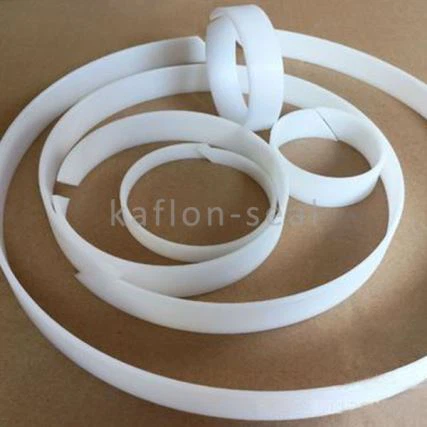
Now, PTFE, or Polytetrafluoroethylene, is a super popular material for guide rings. It's got some amazing properties like low friction, high chemical resistance, and excellent thermal stability. But what about its shear strength?
PTFE has a relatively low shear strength compared to some other materials. This is mainly because of its molecular structure. PTFE molecules are arranged in a way that allows them to slide past each other quite easily. While this gives PTFE its famous non - stick and low - friction properties, it also means that it can be more prone to shear deformation under high loads.


However, don't let that scare you off. The low shear strength of PTFE isn't always a bad thing. In many applications where the guide rings are used, the loads are relatively low, and the low friction of PTFE is more important. For example, in precision machinery or equipment where smooth movement is crucial, PTFE guide rings can work like a charm.
But if you're dealing with high - load applications, there are ways to improve the shear strength of PTFE guide rings. One common method is to add fillers to the PTFE. Fillers like glass fibers, carbon fibers, or bronze powder can significantly enhance the shear strength of the material. These fillers act as reinforcement, preventing the PTFE molecules from sliding past each other so easily.
When we talk about the shear strength of PTFE guide rings, it's also important to consider the manufacturing process. The way the guide rings are made can have a big impact on their shear strength. For instance, proper molding and sintering techniques can ensure that the PTFE material is well - consolidated, which in turn improves its shear resistance.
Now, let's compare PTFE guide rings with some other types of guide rings. POM Guide Rings are another popular option. POM, or Polyoxymethylene, has a higher shear strength than PTFE. It's a more rigid material and can handle higher loads without deforming as easily. However, POM doesn't have the same low - friction properties as PTFE, so it might not be the best choice for applications where smooth movement is a top priority.
Another alternative is Hydraulic Polyurethane Wear Ring. Polyurethane wear rings are known for their excellent abrasion resistance and good mechanical properties. They can also have a relatively high shear strength, especially in comparison to PTFE. But like POM, they don't offer the same level of chemical resistance and low friction as PTFE.
So, how do you decide if PTFE guide rings are the right choice for your application? Well, you need to consider a few factors. First, think about the load conditions. If the loads are low and you need a material with low friction, PTFE is a great option. But if you're dealing with high loads, you might want to look into using filled PTFE or consider other materials like POM or polyurethane.
You also need to think about the environment in which the guide rings will be used. If the application involves exposure to chemicals or high temperatures, PTFE's chemical resistance and thermal stability make it a strong candidate.
As a supplier of PTFE Guide Rings, I've seen firsthand how important it is to choose the right guide rings for the job. We offer a wide range of PTFE guide rings, including those with different fillers to suit various applications. Whether you're working on a small - scale precision project or a large - scale industrial application, we can help you find the perfect guide rings.
If you're in the market for guide rings and have questions about shear strength or any other properties, don't hesitate to reach out. We're here to help you make the best decision for your specific needs. Whether you need more information, samples, or want to discuss a potential order, we're just a message away.
In conclusion, while PTFE guide rings may have a relatively low shear strength compared to some other materials, they offer a unique combination of properties that make them a great choice for many applications. With the right modifications and careful consideration of your application requirements, PTFE guide rings can perform exceptionally well. So, if you're looking for reliable guide rings, give PTFE a chance.
References:
- "Engineering Plastics Handbook" - A comprehensive guide on the properties and applications of various engineering plastics, including PTFE.
- Industry research papers on the mechanical properties of PTFE and its applications in guide rings.