


 Popular Blog Posts



 Blog
BlogF200 PTFE Virgin, a high - performance polymer, is well - known for its outstanding chemical resistance, low friction coefficient, and excellent electrical insulation properties. As a supplier of F200 PTFE Virgin, I have in - depth knowledge about this material and the machining methods that are most suitable for it. In this blog, I will explore various machining techniques that can be employed to shape F200 PTFE Virgin into useful products.


1. Turning
Turning is a fundamental machining process that involves rotating the workpiece while a cutting tool removes material from its outer diameter. For F200 PTFE Virgin, turning can be an effective method to create cylindrical parts such as rods and shafts.
One of the key considerations in turning F200 PTFE Virgin is the choice of cutting tool. High - speed steel (HSS) tools are often a good option due to their relatively low cost and ability to maintain sharp edges. However, carbide - tipped tools can also be used for higher - volume production or when greater precision is required. The cutting speed should be carefully controlled. Since PTFE has a relatively low melting point, excessive cutting speed can cause the material to melt and stick to the cutting tool. A typical cutting speed for F200 PTFE Virgin in turning operations ranges from 100 to 300 surface feet per minute (SFM).
Another important factor is the feed rate. A slow and steady feed rate helps prevent the material from chipping or tearing. A feed rate of 0.002 to 0.01 inches per revolution is commonly used. Additionally, proper lubrication can reduce friction and heat generation. Mineral oil or a water - soluble coolant can be applied during the turning process to improve the surface finish and extend the tool life.
2. Milling
Milling is a versatile machining process that can be used to create complex shapes, slots, and pockets in F200 PTFE Virgin. End mills, face mills, and ball - nose mills are commonly used in milling operations.
When milling F200 PTFE Virgin, it is crucial to select the appropriate cutter geometry. Cutters with a large number of flutes can provide a smoother cut, but they may also be more prone to clogging with the soft PTFE material. A two - or three - flute end mill is often a good choice for general milling applications. Similar to turning, the cutting speed and feed rate need to be carefully adjusted. A cutting speed of 150 to 400 SFM and a feed rate of 0.001 to 0.005 inches per tooth are typical for F200 PTFE Virgin.
Cooling is also essential in milling. In some cases, using a vacuum system to remove the chips can prevent them from re - melting and sticking to the workpiece or the cutter. This helps maintain the accuracy of the machining and the quality of the surface finish.
3. Drilling
Drilling is used to create holes in F200 PTFE Virgin. Standard twist drills can be used, but they may need to be sharpened frequently to ensure clean holes. The point angle of the drill should be around 118 degrees, which is suitable for most drilling applications in PTFE.
To prevent the material from deforming or cracking during drilling, a slow spindle speed is recommended. A speed of 500 to 1500 revolutions per minute (RPM) is often appropriate. The feed rate should be relatively slow as well, typically around 0.001 to 0.003 inches per revolution. Backing up the workpiece with a piece of scrap material can also help reduce the risk of delamination or burring on the exit side of the hole.
4. Grinding
Grinding can be used to achieve a very smooth surface finish on F200 PTFE Virgin parts. However, due to the soft and elastic nature of PTFE, grinding requires special attention. A fine - grit grinding wheel is usually selected to avoid excessive material removal and to obtain a high - quality surface.
The grinding pressure should be kept low to prevent the material from smearing or melting. Using a coolant during grinding is essential to dissipate heat. Water - based coolants are commonly used, but they need to be carefully formulated to prevent corrosion of the grinding equipment. The grinding speed should be relatively slow, typically around 1500 to 3000 surface feet per minute.
5. Tapping
Tapping is the process of creating internal threads in F200 PTFE Virgin. Since PTFE is a soft material, special taps are often required. Spiral - point taps or spiral - flute taps can be more effective in PTFE compared to standard taps. The spiral design helps to evacuate the chips and reduces the risk of tap breakage.
The tapping speed should be slow, usually around 10 to 30 RPM. Lubrication is also crucial in tapping. A light - bodied oil or a PTFE - based lubricant can be applied to the tap to reduce friction and prevent the threads from deforming.
Comparison with Related PTFE Materials
It is also interesting to compare F200 PTFE Virgin with other related PTFE materials in terms of machining. For example, F215 Carbon Firber Filled PTFE has enhanced mechanical properties due to the addition of carbon fiber. However, the carbon fiber can make the material more abrasive, which may require more robust cutting tools and different machining parameters.
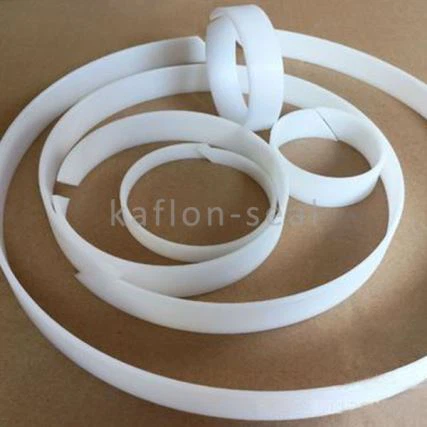
Pure PTFE spiral elastic back up ring is a product made from pure PTFE. The machining of this type of product may focus more on achieving high - precision dimensions and a smooth surface finish to ensure its sealing performance.
F203 15% GLASS Fiber Filled PTFE is another filled PTFE material. The glass fiber can improve the stiffness and wear resistance of the material, but it also makes the machining more challenging as the glass fiber can cause tool wear and may require higher cutting forces.
Conclusion
In conclusion, F200 PTFE Virgin offers a wide range of applications due to its excellent properties. However, machining this material requires careful consideration of various factors such as cutting tool selection, cutting speed, feed rate, and lubrication. Each machining method - turning, milling, drilling, grinding, and tapping - has its own unique requirements and challenges when working with F200 PTFE Virgin.
As a supplier of F200 PTFE Virgin, I am committed to providing high - quality materials and technical support to our customers. If you are interested in purchasing F200 PTFE Virgin or have any questions about its machining, please feel free to contact us for further discussion and negotiation. We are eager to work with you to meet your specific needs and achieve the best results in your projects.
References
- "Machining of Plastics" by Society of Plastics Engineers.
- "Handbook of PTFE Technology" by various authors in the field of polymer engineering.