


 Popular Blog Posts



 Blog
BlogWhat is the Young's modulus of PTFE Guide Rings?
As a dedicated supplier of PTFE guide rings, I often encounter inquiries from customers about the technical properties of our products. One of the most frequently asked questions is about the Young's modulus of PTFE guide rings. In this blog post, I'll delve into the concept of Young's modulus, its significance for PTFE guide rings, and how it impacts the performance of these essential components.
Understanding Young's Modulus
Young's modulus, also known as the modulus of elasticity, is a fundamental material property that measures the stiffness or rigidity of a material. It's defined as the ratio of stress to strain within the elastic limit of a material. In simpler terms, it tells us how much a material will deform under a given amount of stress. The formula for Young's modulus (E) is:
[ E=\frac{\sigma}{\epsilon} ]
Where:
- (\sigma) is the stress applied to the material (force per unit area).
- (\epsilon) is the corresponding strain (the fractional change in length) within the elastic range.
A high Young's modulus indicates that a material is stiff and will deform less under stress, while a low Young's modulus means the material is more flexible and will undergo greater deformation.
Young's Modulus of PTFE
Polytetrafluoroethylene (PTFE), commonly known as Teflon, is a well - known fluoropolymer with a wide range of applications due to its excellent chemical resistance, low friction coefficient, and high thermal stability. The Young's modulus of pure PTFE typically ranges from about 400 to 600 MPa (megapascals). However, the actual value can vary depending on factors such as the manufacturing process, the presence of fillers or additives, and the temperature.
When PTFE is used to make guide rings, these factors can be carefully controlled to optimize the material's properties. For example, adding fillers like glass fibers, carbon fibers, or bronze powder can significantly increase the Young's modulus of PTFE, making the guide rings stiffer and more resistant to deformation.
Significance of Young's Modulus for PTFE Guide Rings
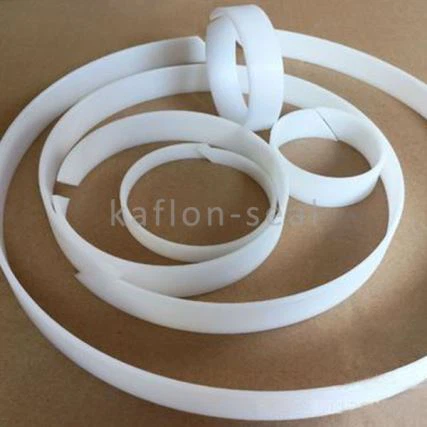
In the context of PTFE guide rings, the Young's modulus plays a crucial role in determining their performance. Guide rings are used in hydraulic and pneumatic cylinders to guide the piston or rod, prevent metal - to - metal contact, and ensure smooth and precise operation.
- Load - bearing capacity: A higher Young's modulus means that the guide ring can withstand greater radial loads without excessive deformation. This is essential in applications where the cylinder operates under high pressure, as the guide ring needs to maintain its shape and support the piston or rod effectively.
- Wear resistance: Stiffer guide rings (higher Young's modulus) are generally more resistant to wear. When the guide ring deforms less under load, there is less friction and wear between the ring and the cylinder wall or rod. This leads to a longer service life and reduced maintenance requirements.
- Alignment and precision: The stiffness of the guide ring helps to maintain proper alignment of the piston or rod within the cylinder. This is crucial for achieving accurate and consistent movement, which is especially important in applications such as precision machining, robotics, and aerospace.
Comparison with Other Materials
To better understand the significance of the Young's modulus of PTFE guide rings, it's useful to compare them with guide rings made from other materials. For example, POM Guide Rings (made from polyoxymethylene) typically have a Young's modulus in the range of 2500 - 3500 MPa, which is significantly higher than that of pure PTFE. This means that POM guide rings are much stiffer and can handle higher loads. However, PTFE guide rings have the advantage of a lower friction coefficient, which can result in smoother operation and less energy consumption.
Another comparison can be made with POM Hydraulic Wiper. While POM hydraulic wipers are also known for their high stiffness and wear resistance, PTFE guide rings offer better chemical resistance and can be used in more aggressive environments.
Factors Affecting the Young's Modulus of PTFE Guide Rings
As mentioned earlier, several factors can influence the Young's modulus of PTFE guide rings:
- Fillers and additives: As discussed, adding fillers such as glass fibers, carbon fibers, or bronze powder can increase the Young's modulus of PTFE. The type and amount of filler used can be adjusted to achieve the desired stiffness and other properties.
- Temperature: The Young's modulus of PTFE decreases with increasing temperature. At elevated temperatures, the polymer chains become more mobile, and the material becomes more flexible. This is an important consideration in applications where the guide rings are exposed to high - temperature environments.
- Manufacturing process: The way the PTFE guide ring is manufactured can also affect its Young's modulus. Processes such as compression molding, sintering, and machining can introduce different levels of stress and orientation in the material, which can impact its stiffness.
Measuring the Young's Modulus of PTFE Guide Rings
The Young's modulus of PTFE guide rings can be measured using standard mechanical testing methods, such as a tensile test. In a tensile test, a sample of the guide ring material is subjected to a gradually increasing tensile force, and the resulting strain is measured. The stress - strain curve is then plotted, and the Young's modulus is calculated from the slope of the linear portion of the curve within the elastic range.
However, it's important to note that the actual conditions in which the guide ring operates may be different from the conditions of the tensile test. Therefore, in addition to laboratory testing, real - world performance testing is also necessary to fully evaluate the suitability of the guide ring for a particular application.
Customizing PTFE Guide Rings Based on Young's Modulus
As a supplier of PTFE Guide Rings, we understand that different applications have different requirements for the Young's modulus of the guide rings. That's why we offer customized solutions to meet the specific needs of our customers.
We can adjust the formulation of the PTFE material by adding different types and amounts of fillers to achieve the desired Young's modulus. Whether you need a stiffer guide ring for high - load applications or a more flexible one for low - friction operation, we can work with you to develop the optimal solution.


Conclusion
The Young's modulus of PTFE guide rings is a critical property that affects their load - bearing capacity, wear resistance, alignment, and overall performance. By understanding the concept of Young's modulus and how it can be influenced by factors such as fillers, temperature, and manufacturing process, we can provide high - quality PTFE guide rings that meet the diverse needs of our customers.
If you're in the market for PTFE guide rings and have specific requirements regarding the Young's modulus or other properties, we'd be more than happy to discuss your needs and provide you with the best solution. Contact us today to start a conversation about your guide ring requirements and explore how our products can enhance the performance of your hydraulic or pneumatic systems.
References
- Callister, W. D., & Rethwisch, D. G. (2017). Materials Science and Engineering: An Introduction. Wiley.
- Van Vlack, L. H. (1989). Elements of Materials Science and Engineering. Addison - Wesley.