


 Popular Blog Posts



 Blog
BlogHey there! As a supplier of PTFE O Rings, I often get asked about how to choose the right size. It's not as straightforward as it might seem at first glance, but with a bit of know - how, you can make the best decision for your application.
First off, let's talk about why getting the right size of a PTFE O Ring matters. An O Ring that's too big won't create a proper seal. It'll flop around, and you'll end up with leaks, which can be a real headache in industrial or mechanical applications. On the other hand, an O Ring that's too small will be over - compressed. This can lead to premature wear and tear, and it might even damage the O Ring itself, again causing leaks.
Measuring the Groove
The first step in choosing the right size is to measure the groove where the PTFE O Ring will be placed. You need to measure two key dimensions: the groove diameter and the groove width.
The groove diameter is the inside diameter of the space where the O Ring will sit. To measure this accurately, you can use a caliper. Make sure you measure at several points around the groove because sometimes, grooves can be slightly out of round. If you get different measurements, take the average.
The groove width is how wide the groove is from one side to the other. This measurement is also crucial because the O Ring needs to fit snugly in the groove. If the groove is too wide, the O Ring won't be compressed enough to create a seal. If it's too narrow, the O Ring will be squeezed too tightly.


Considering the Compression
Once you have your groove measurements, you need to think about compression. Compression is how much the O Ring gets squeezed when it's installed in the groove. A good rule of thumb is to aim for a compression of about 10 - 30%.
If you're dealing with a static application, like sealing a pipe joint that doesn't move, you can go with a compression on the higher end of that range. For dynamic applications, where there's movement, like in a piston, you might want to stick to the lower end. Too much compression in a dynamic application can cause excessive friction, which can wear out the O Ring faster.
Tolerances
Tolerances are another important factor. No measurement is perfect, and there will always be a little bit of variation. When you're choosing a PTFE O Ring, you need to make sure that the tolerances of the O Ring match the tolerances of your groove.
For example, if your groove diameter has a tolerance of plus or minus 0.1 mm, you need to choose an O Ring with a similar tolerance. Otherwise, you might end up with an O Ring that's either too big or too small, even if your initial measurements seemed to match.
Application - Specific Considerations
Different applications have different requirements. For instance, if you're working in a high - temperature environment, you need to make sure the PTFE O Ring you choose can handle the heat. PTFE is known for its good heat resistance, but some formulations are better than others.
If you're dealing with chemicals, you also need to be careful. PTFE is resistant to many chemicals, but there are some that can still damage it. Make sure the O Ring you select is compatible with the chemicals it will come into contact with.
Our Product Range
At our company, we offer a wide range of PTFE O Rings to meet various needs. We also have some other great products like the HW03 Face Sealing Helicoil Energized Seal With Back Up Ring. This seal is designed for face - sealing applications and comes with a back - up ring for added reliability.
Another product is the HT02 RPTFE Spring Energized Seal. It's made from RPTFE and has a spring - energized design, which makes it great for applications where you need a tight seal.
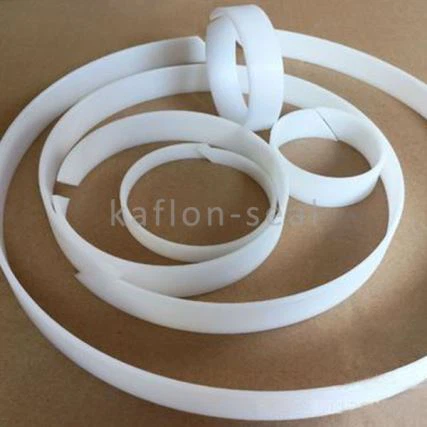
We also have the Reciprocating Seal Phenolic Guide Ring. This guide ring is perfect for reciprocating applications, providing support and reducing wear.
Conclusion
Choosing the right size of a PTFE O Ring is a multi - step process. You need to measure your groove accurately, consider compression and tolerances, and take into account the specific requirements of your application. If you're not sure where to start, don't worry! Our team of experts is here to help.
If you're interested in our PTFE O Rings or any of our other products, we'd love to have a chat with you. Whether you're a small business or a large industrial operation, we can work with you to find the perfect sealing solution. Just reach out to us, and we'll start the conversation about your needs.
References
- "Sealing Technology Handbook" by John H. Bickford
- "O - Ring Handbook" published by Parker Hannifin Corporation