


 Popular Blog Posts



 Blog
BlogCan PTFE Guide Rings be used in aerospace applications?
As a supplier of PTFE Guide Rings, I am often asked about the suitability of our products for aerospace applications. This is a critical question, considering the high - stakes nature of the aerospace industry where reliability, performance, and safety are of utmost importance. In this blog, I will delve into the characteristics of PTFE Guide Rings and analyze their potential use in aerospace.
Understanding PTFE Guide Rings
PTFE, or polytetrafluoroethylene, is a synthetic fluoropolymer of tetrafluoroethylene. It is well - known for its unique properties. PTFE has an extremely low coefficient of friction, which means that it can reduce the amount of energy lost due to friction in mechanical systems. This property is particularly useful in applications where smooth and efficient movement is required.
PTFE also has excellent chemical resistance. It can withstand a wide range of chemicals, including strong acids, bases, and organic solvents. This makes it suitable for use in environments where it may come into contact with various fluids. Additionally, PTFE has a high melting point and good thermal stability, allowing it to maintain its properties at elevated temperatures.
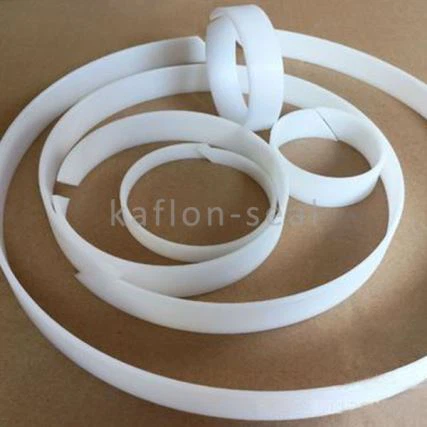
PTFE Guide Rings are designed to guide moving parts within a mechanical system, ensuring proper alignment and reducing wear and tear. They are commonly used in hydraulic and pneumatic cylinders, among other applications. You can find more information about our PTFE Guide Rings on our website.
Requirements in Aerospace Applications
The aerospace industry has some of the most stringent requirements for materials and components. First and foremost, weight is a critical factor. Every extra pound in an aircraft or spacecraft adds to the fuel consumption and reduces the overall efficiency. Therefore, materials used in aerospace applications need to be lightweight without sacrificing strength and performance.
In addition to weight, reliability is non - negotiable. Components in aerospace systems must operate flawlessly under extreme conditions, including high and low temperatures, high pressures, and high - speed movements. They also need to have a long service life to minimize maintenance and replacement costs.
Another important requirement is resistance to harsh environments. Aerospace vehicles are exposed to a variety of elements, such as radiation, ozone, and chemical contaminants. Materials used in these applications must be able to withstand these environmental factors without degrading.
Advantages of PTFE Guide Rings in Aerospace
One of the key advantages of PTFE Guide Rings in aerospace applications is their low coefficient of friction. In aerospace mechanical systems, such as actuators and control mechanisms, reducing friction can lead to more efficient operation. This means less energy is wasted as heat, and the overall system can operate with greater precision. For example, in the control surfaces of an aircraft, smooth and precise movement is essential for safe flight. PTFE Guide Rings can help achieve this by minimizing friction between moving parts.
The chemical resistance of PTFE is also a significant benefit. In aerospace, various fluids are used, such as hydraulic fluids, lubricants, and coolants. PTFE Guide Rings can resist the corrosive effects of these fluids, ensuring long - term performance and reliability. This is especially important in hydraulic systems, where the integrity of the components is crucial for proper operation.
The thermal stability of PTFE is another advantage. Aerospace vehicles experience a wide range of temperatures, from the extreme cold of high - altitude flight to the heat generated during re - entry in the case of spacecraft. PTFE Guide Rings can maintain their mechanical properties over this broad temperature range, ensuring consistent performance in all conditions.
Challenges and Limitations
Despite their many advantages, PTFE Guide Rings also face some challenges when it comes to aerospace applications. One of the main challenges is their relatively low strength compared to some other materials. In high - stress applications, such as in the landing gear or high - thrust rocket engines, PTFE Guide Rings may not be able to withstand the forces involved. However, this can be mitigated by using PTFE composites or by designing the guide rings in a way that distributes the load more evenly.
Another limitation is the cost. PTFE is a relatively expensive material, and the manufacturing process for PTFE Guide Rings can also be complex. This can make the overall cost of using PTFE Guide Rings in aerospace applications higher compared to some other alternatives. However, when considering the long - term benefits in terms of performance and reliability, the cost may be justified.
Comparison with Other Materials
In the aerospace industry, there are other materials that are commonly used for guide rings. For example, POM Hydraulic Wiper is a popular choice. POM, or polyoxymethylene, is a high - strength engineering plastic. It has good mechanical properties and is relatively inexpensive. However, POM has a higher coefficient of friction compared to PTFE, which can lead to more energy loss in the system.
Hydraulic Polyurethane Wear Ring is another alternative. Polyurethane has good wear resistance and can be formulated to have different hardness levels. However, it may not have the same level of chemical and thermal resistance as PTFE.
Case Studies and Applications
There are already some successful applications of PTFE Guide Rings in the aerospace industry. In some small - scale aircraft, PTFE Guide Rings are used in the hydraulic actuators for the flaps and landing gear. The low friction of PTFE helps to ensure smooth and precise movement of these components, which is essential for safe take - off and landing.
In spacecraft, PTFE Guide Rings can be used in the control mechanisms for the solar panels. The thermal stability of PTFE allows these guide rings to operate properly in the extreme temperature variations experienced in space.
Conclusion
In conclusion, PTFE Guide Rings have significant potential for use in aerospace applications. Their low coefficient of friction, chemical resistance, and thermal stability make them well - suited for many aerospace systems. However, challenges such as low strength and high cost need to be carefully considered.
As a supplier of PTFE Guide Rings, we are committed to providing high - quality products that meet the demanding requirements of the aerospace industry. We are constantly working on improving the performance of our PTFE Guide Rings and finding innovative solutions to overcome the existing limitations.


If you are involved in the aerospace industry and are interested in exploring the use of PTFE Guide Rings in your applications, we would be more than happy to discuss your specific needs and requirements. Contact us to start a procurement negotiation and find out how our PTFE Guide Rings can enhance the performance and reliability of your aerospace systems.
References
- "Handbook of PTFE and Other Fluoropolymers" by Harry Allcock, Frederick Lampe, and James Mark.
- "Aerospace Materials and Their Applications" by William F. Smith and Javad Hashemi.