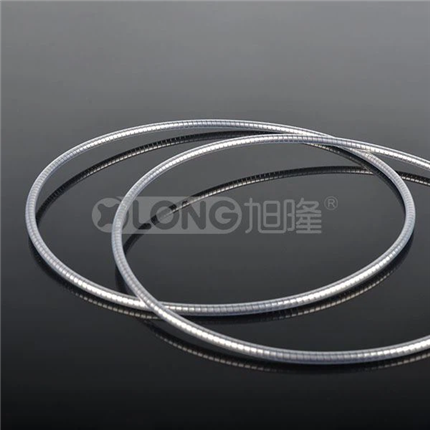
Composition and Reinforcement
RPTFE is PTFE (polytetrafluoroethylene) that has been enhanced with a reinforcing material. The most common reinforcement is glass fiber, but other materials like carbon fiber or bronze can also be used. The addition of these reinforcing agents significantly improves the mechanical properties of PTFE. For example, glass - fiber - reinforced RPTFE has increased tensile strength and better resistance to creep (deformation under a constant load) compared to pure PTFE.
Properties
High Temperature Resistance:
Like pure PTFE, RPTFE can withstand relatively high temperatures. It has a continuous use temperature range of around - 200°C to +260°C. This makes it suitable for applications where components are exposed to extreme heat, such as in some industrial ovens or high - temperature piping systems.
Chemical Resistance:
It exhibits excellent resistance to a wide range of chemicals, including strong acids, bases, and solvents. For example, it can resist the corrosive effects of hydrochloric acid and sodium hydroxide solutions, which makes it ideal for use in chemical processing equipment such as reactors and storage tanks.
Low Friction Coefficient:
RPTFE maintains the low - friction characteristics of PTFE. Its friction coefficient is typically around 0.05 - 0.2, depending on the load and surface conditions. This low friction makes it useful in applications where parts need to slide or rotate smoothly, such as in bearings and seals.
Enhanced Mechanical Strength:
The reinforcement gives RPTFE better mechanical strength than pure PTFE. It has a higher modulus of elasticity and can withstand greater compressive and tensile forces. In applications such as gaskets and seals, this enhanced strength allows for more reliable sealing under higher pressures.
Manufacturing Process
The manufacturing process of RPTFE involves mixing the PTFE resin with the reinforcing material in a specific ratio. The mixture is then processed through techniques such as compression molding or extrusion. In compression molding, the RPTFE mixture is placed in a mold and subjected to high pressure and temperature to form the desired shape. Extrusion, on the other hand, is used to produce continuous shapes like tubes or rods. The manufacturing process needs to be carefully controlled to ensure the uniform distribution of the reinforcing material throughout the PTFE matrix for optimal performance.
Applications
Seals and Gaskets:
RPTFE is widely used in the production of seals and gaskets. In the oil and gas industry, for example, RPTFE gaskets are used to seal flanges in pipelines and equipment. The combination of chemical resistance and enhanced mechanical strength makes it suitable for withstanding the high pressures and corrosive environments found in oil and gas production and processing.
Bearings:
Its low - friction and good mechanical properties make it a suitable material for bearings. In machinery and equipment where smooth rotation and resistance to wear are essential, such as in conveyor systems and small motors, RPTFE - based bearings can provide reliable performance.
Electrical Insulation:
RPTFE's excellent dielectric properties and resistance to high temperatures make it useful for electrical insulation. It can be used in applications such as wire coatings and insulators in high - voltage equipment to prevent electrical leakage and short - circuits.